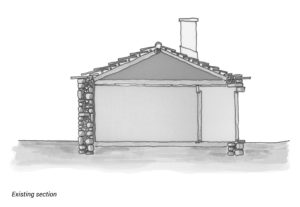
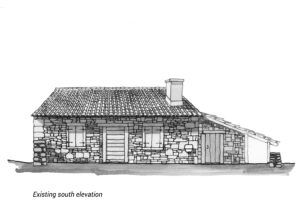
Doors and windows

Winter is knocking on our doors again. It’s time to put down the trowel, reflect on the year gone by and share all the steps we managed to make on our path of the stone house renovation.

Last year we managed to brush off the marks of time off the stone walls and protect them with a roof. Before the next stages of refurbishment took place and we started with the renovation of the interior, the outer shell needed to be waterproof. We filled up the smaller holes with mortar. What belongs in the bigger remaining openings? Doors and windows 🙂


I do have to confess I still get confused with the Istrian time warp; it takes me by surprise again and again. The perfect example is the story about how the doors and windows came into existence.

The first time I met (the third) carpenter on site was on 16th February. We went through all the plans, looked at every technicality, measured every possible dimension and agreed on every detail. 1 big door, 2 smaller windows and a big glass wall were to be made and installed in 3 months. Far from cheap but the quality would be worth it. It sounded fabulous and we shook hands on it.

The first complication was the steel frame on the east wall. It needed to be installed before the final measurements for the glass wall could be completed. After a year of searching for anyone that would be willing to make a non-corroding steel frame and talking to all the uninterested companies in the vicinity I gave up the search for local production and ordered it in Ljubljana. After I waited quite some time for the order to be made, it was done exactly as we agreed upon (thank you Klemen!). Then some more waiting for the zinc plant in Austria to accomplish its anti-corroding magic, some more waiting for the painting of the frame to take place and I could finally transport it to the coast. The steel frame was installed on 10th July.
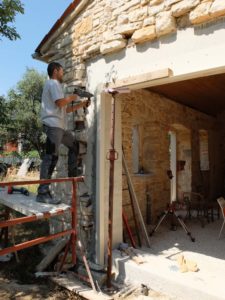
    

Now everything was ready and since we agreed on the schedule with the carpenter there will be no more waiting for the manufacturing of the doors, right?

As it turned out, the carpenter did not order the wood yet so there was no appropriate material to manufacture the elements yet. So we waited for the ordered wood to make its appearance.

After the wood came there was no suitable steel track for the glass window. Why? The manufacturer stopped delivering the product to Croatia and soon I was looking everywhere, including all the neighbouring countries to import the part myself. Since it was the beginning of August already everyone was off for vacation.

After some remarkable stunts we managed to get the steel track. There were the wood and the track, but there was no suitable varnish. Then the varnish came and the weather was not right for the application. What else could we have possibly still been waiting for? Oh yeah, I forgot the yearly vacation the carpenter’s company takes in August that they forgot to mention to me…


The doors and windows were finally installed on the 31th August. Even though it took almost 4 months longer that agreed upon, I was happy with the accomplishment. They looked beautiful and for the first week I couldn’t stop folding the glass wall…


What were the reflections behind the outer appearance of the house?

It is always hard to find the right balance between preserving the old and implementing the new. How do you specify the parameters that make out the right balance?

Vitruvius put it neatly: firmitas, utilitas, venustas.

Firmitas (strength)

It was highly important that the majority of the old stone volume was preserved, but looking at the house from the structural stability perspective, the strength of the east wall was questionable. The original chimney was too heavy and unstable for the wood structure of the roof. The bulky thing broke the supporting structure and leaned its entire weight on the corner of the east wall making a crack in the wall about 10 cm wide.


Utilitas (functionality)

Times change, people’s lives change and the use of buildings with it. Do we want to smother potential and life with the rigidity of the past? I don’t believe absolute preservation is the right approach. This house has seen many glorious moments when people enjoyed their time with each other on its premises. I find this to be one of the key elements of this renovation: to give the people as many options as we can provide them with so they can enjoy the true beauty of the moment in this magical setting. Some people look for tranquillity, some look for nature, some for companionship. Be what it may, cutting an opening in the only wall where we were allowed to do that – in order to connect the inside of the house with the outside space – seemed like the right choice.

I am aware it is not a traditional feature by any stretch of the imagination. But do I want to relish the outside while cooking under the pergola and at the same time have the option to share my time with someone inside the house? Yes. So that’s why I yielded to making a big opening in the east wall, a folding glass surface 3.7 m wide and 2.3 m high.

For the times they are a changin’ (B.D.1964).


Venustas (beauty)

I’ve come to cherish the simplicity of form, the usage of the materials in the close proximity of the building and the durability of technically well executed details. Beauty? I will let everyone judge that for themselves.

Renovating the existing house

There were a lot of discussions about what to place inside the house, how to use the existing volume and how to find the right balance between the old and the new. What is minimum, what is necessary and what is enough always turned into lengthy discussions where cultural background and personal preferences played the most important roles. Every person presented with the circumstances saw one and only logical solution for the given situation yet astonishingly no 2 people ever had the same idea 🙂

The concept I was after mixed the traditional and contemporary renovation approaches with the emphasis on one or the other according to the given detail or building element. Complying with all the legislation and laws valid for our case was a must. We tried out drawing every possible version from implementing a gallery to partly closing up the space on every side of the building. Conclusion: everything that you place inside 35 m2 takes up too much space.

What are the bare minimums in this case? The solution for most people was a point somewhere between 2 extremes: the luxury of having everything at hand on one pole and admiring a magnificent empty volume while kicking the functional facilities outside on the other. Bathroom or no bathroom, that was the menacing question for it meant a separation of the volume that was already very small. The commodity to some extent prevailed and we decided the bare minimum was in our case constituted of a place to sleep, a place to cook and a place for personal hygiene (toilet, sink, shower).


How do we change the closed dark insides into a self-sufficient unit, full of light and connected to the outside space?


1. Placing everything that we need for temporary use on a single level within the house.


Basic live-eat-sleep facilities will be placed in the heart of the restored house, a partition wall extending to the ceiling will separate the bathroom and storage/technical room from the rest of the volume.

East part will see the most changes. In order to permit the light to enter, two major interventions took place: the storage unit outside the east wall was removed and a big opening carved out of the east wall.

The darkness will be replaced by openness to the sky and a wooden pergola which will host the outside kitchen and a huge table. The connection between the outside and inside will be a 3.80 m wide and 2.25 m high glass wall that will fold away completely when not needed.


2. Increasing the height of the building for 60 cm, utilizing the full height of the volume (removing the suspended ceiling) and exposing the stone walls.


The walls made of stone are the most amazing component of this whole story so we are keeping those and letting them be visible from the outside (traditional to some extent) as well as from the inside (contemporary or at least not traditional).


3. Preserving the façades


The south façade is gorgeous so we are keeping it mostly as it is: the 2 windows and the entry door remain in the same positions, all three slightly higher (functionality).

The west and the north façade border the neighboring plot so no openings are allowed – we’re keeping them as (closed as) they are.

East wall gains a humongous opening forming the connection between the house and the nature.


I would like to dedicate a separate post to the topic of materials since it was such an important subject in this project – but let me just mention a few highlights: wooden floor and furniture, use of clay for the ceiling and partly also wall plaster, tadelakt in the bathroom.

Architectural background

The more I learn about architecture, the more complex the field seems. It has so many layers – history, locus, building regulations, visions, ideas, aesthetic norms, economics and finances, cultural beliefs, interests of every kind, (geo)political amongst them, (psychological) issues of the people involved. The list goes on and on. That makes architecture so interesting on one hand and so exhausting on the other.

I am amazed how this tiny house manages to stimulate imagination of each individual in such a way that everyone comes up with a completely unique solution. I guess because it’s small enough to let each person express their ideas and taste according to the individual experiences and beliefs without having them shaped by some commonly accepted concepts around living spaces.


So what is my version of what makes sense in the given situation?

As I remember the life here, it was so beautiful because it was so simple. The majority of time was spent outside living and breathing nature in all its ever-changing glory. That was the spirit I was after.

The house itself is gorgeous and adding something new to it, which would match its beauty, proved to be a difficult task. Going through all the versions of additions we discovered that nothing we add will do it justice, so we decided not to add anything at all to the existing volume. Moreover, we decided to only keep the elements that are truly worth keeping and remove everything else. The storage on the east end of the building with its insufficient height wasn’t usable so it had to go.

We were left with 35 m2 nett floor area – how can we expand it to fit normal contemporary needs if we are not going to add anything to the house?

Let’s separate the program units and make rooms in the garden!

So that was the initial idea: the house keeps its outer appearance while being used as the living room (A). The kitchen will be placed outside on the east side of the house (B), the bedroom (C) and bathroom (D) each become a separate unit in the garden. I believe that opens up the possibility for the people to truly experience the beauty of every moment in a day while being connected to nature.


Then bureaucracy enters.

2015: The plot we started with had 230 m2. In total.

2016: Through all the paperwork that we needed to gather to be able to renovate this 60 m2 house legally (yes, there will be a separate post on that) the plot first grew to 251 m2, then to 275 m2 – you have to love Croatian bureaucracy 🙂

2017: Acquired the neighbouring plot to raise the grand total to 562 m2 of surface we can play with.


While the basis for the renovation of this tiny house changed sooooo many times, the ideas of course changed with them.


What is the current situation, what’s the plan?

We are keeping the idea of creating separate units for different programs and spreading them out on the plot.

In phase 1 we will renovate the house that remains the central character in the play and convert it into the living room of the premises.

The newly acquired north garden will be the main entrance with some parking space. We would like to use part of the plot for a tent area, outside living area with an open fireplace and a ping-pong table, all of that combined with permaculture garden plots and art spaces.


The private garden south of the house will host an outside leisure spot that converts into a cosy outdoor bed at night, a couple of deckchairs, an outdoor shower and lots of green bushes between different points of interest to create even more intimate spaces.

In the next phases we hope to continue with bedrooms and a bathroom placed somewhere in the garden. Ideas grow all the time.


Yes, I know – I am gifted for getting myself into somewhat demanding situations; thank god I’m stubborn enough to finish what I’ve started 😉