We finally made it through this year’s prolonged winter, congratulations everyone! I don’t know about you, but I feel like a new person now and I am ready to take up new adventures.
So what is left of the last year’s restoration tale, before we continue with this year’s mission to finish the renovation?
As I’m sure you have already noticed, there are many mysteries the stone can reveal to us. It can perform in astonishing compositions when it’s handled with great care by professionals.
We’ve built foundations, replaced the unstable parts of the walls, changed the openings and constructed arches. Then all we needed to do is raise the walls a little bit, fill in the joints from the outside and inside to plug the holes in the walls and fill it up with liquid mortar.
Let’s do it the old school way 🙂


You grab a string, position it on steel bars at appropriate heights to shape the desired form of the house and secure it with a stone.


Repeat on all 4 sides of the house and fill in the missing parts of the façade with stonework up to the chosen vertex.

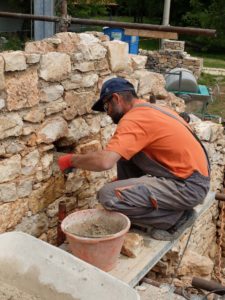
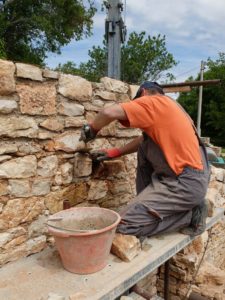
Next step is to make sure there are no cavities in the walls. Yes, that’s right: scratch out any old mortar that remained in the walls, then fill up all the joints with new mortar.
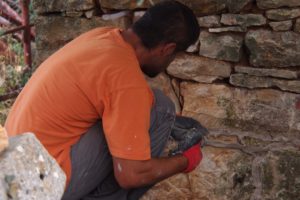

If this were a normal house with a normal client the story would end here. Because this is not the case, the client (yes, that’s me:) wanted the stones to stand out a few centimetres out of the mortar. What does that mean? Well, scratching some new mortar out again until the client is happy with the depth of the joints 🙂
The reason behind me being tenacious in this case was this: the sealant between the stones of the house used to be made out of orange coloured mortar (Istrian earth) which accentuated each individual stone in the wall.

The replacing mortar’s colour was very similar to the colour of the stones which could mean the whole wall could visually melt into a soup. I liked the accentuated stone structure and the way in which I thought we could accomplish the same effect was by pushing the joints a few centimetres into the wall so the stonework would be underlined by the shade around each stone.


I am happy I made that decision. Besides achieving the desired effect on the walls a by-product were some of the finest moments of last year’s summer. Mladen, Kristijan and I, sitting on the scaffolding, scratching out the joints surrounded only with peaceful nature and discussing random thoughts while deeply immersed in work. Ah, the bliss of working with professionals.

Filling up the walls with mortar (no cement!) was the last step to making the structure as stable and solid as possible without building in any steel wires or apply concrete across the whole surfaces.
During the process of the joint making there were about 200 hoses inserted all across the surface of the walls.
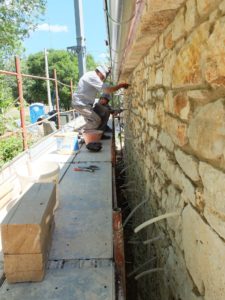

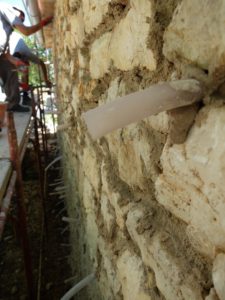
When the joints dry out enough so they are stable (not a problem in the mid summer heat in Croatia), you prepare the mortar for the filling, which needs to be a bit more liquid then the mixture you use for the joints.

Fill up the machine and fill in one hose after another. Start with a hose at the bottom of the wall and pour in just enough material so it starts leaking out of the hose next to it.

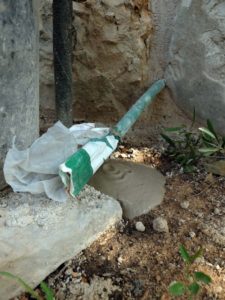
Wait until the first fill solidifies enough and continue with the next hose. All 200 of them, one after the other.
It sounds painstakingly slow, right? That’s exactly what the process felt like.
There was a surprise waiting for us in the wall. A small ornamented gem of antiquity, quietly sitting in the wall all those years just waiting to be discovered. I still don’t know how the team managed to find it because it was built into the wall with its decorative side hidden.
Spolia is a conservationist term used for building stones or decorative sculptures reused in a new construction. The practice was common in late antiquity. Entire obsolete structures are known to have been demolished to enable the construction of the new ones. The practice is of particular interest to (architectural) historians and archaeologists since the gravestones, monuments and architectural fragments of ancientness are frequently found embedded in structures built centuries or millennia later.
I’ll leave it to you to find the exact position of our adorning jewel of former age in the wall. Good luck with the search! 🙂