After putting in all the effort in the last year’s renovation battles, we needed to protect the hard obtained achievements somehow. What sort of a safeguard is the best to protect a house from the weather and other ambience influences? A roof 🙂
We took great care at dismantling the old roof. The goal was to reuse the maximum quantity of the substance used for the original cover. Unfortunately, the whole wooden construction was eaten away by termites.


The only material, that was still usable, was the old roof tiles. Of the 1500 we took down, about 1000 could be reused again. The roof tiles need to be attached to the new construction somehow in order for them not to fall off the pitch of the roof. Nowadays 3 methods are commonly used: they can be glued to the surface with mortar, glued to the surface with polyurethane sealing foam or they can be hammered to the wooden battens.
The mortar was too heavy for the foreseen construction, the polyurethane foam was a no-go for me, so the option we were left with, was putting a nail through each tile to attach it. There weren’t any holes in them yet so Matej took on the arduous task of drilling through a 1000 tiles last summer. My deepest gratitude to yet another astonishing human being for putting in so much time and effort needed to bring my dream a step closer to reality.


The cover made of roof tiles was taken care of, what else is needed for a proper roof? Construction and thermal insulation.
It was always clear the construction was going to be made out of wood. It was an endeavour to find an 8m long beam of the proper height that would serve as a main supporting agent. I was enthusiastic about finding and old oak timber but after a month of fruitless attempts we’ve settled on a company in Bani (a village 80 km away) manufacturing poles out of new spruce wood in appropriate length. We were still left with the issue of the height of the beam though, because the material available did not have the height our construction engineer proposed for it. After some contemplation we have found the solution: we got two beams, stacked them one on top of the other and connected them vertically with wooden pins. It took quite some coordination to get a skilled carpenter that could pull away such a stunt but we found the right person and the ridge beam was built in.

We’ve prepared a dent between the outer layers of stone on the top of the wall for the concrete crown and the mixture was poured onto the steel reinforcement that was laid out inside the dent beforehand.


The wall plates (spruce) were connected to the steel spikes attached to the concrete crown beforehand, consequent parts of the timber construction were the rafters out of larch.


It was quite a struggle to decide on the right materials to use for the complete composition of the roof and the insulation part was proven to be very tricky. Ever since I came in contact with straw as a building material, I thought I was going to use it for the insulation on our roof.
Last year I attended the first Croatian convention on natural building materials and heard that across the country rats have a devastating effect on straw roofs. I wasn’t able to shed second thoughts and started looking for an alternative. Since we are close to Adriatic coast my ideas went as far as seaweed: it has excellent resilience qualities and it has been commonly used for centuries on islands like Læsø in Denmark as cladding and roofing material.


© Holger Leue and realdaniabyogbyg.org
In the end I settled for another idea: wood chips from a local woodworking mixed with lime powder. 
Wood has decent thermal qualities and lime would suppress any desires animals might have to look for a shelter in the roof.

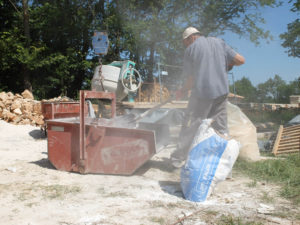
The mixture of the two ingredients was distributed between the boards anchored to the top and bottom side of the rafters. The vapour control layer (paper membrane) was preventing the mixture from falling through the holes between the boards.

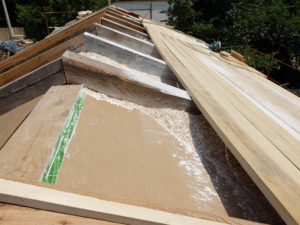
I wanted to prevent the summer overheating with insulation instead of cooling the house with air conditioning, so I wanted to make sure the roof is sufficiently protected. Another layer of lining was foreseen on top of the rafters (hemp insulation) and underneath the rafters (wood fibre insulation).

We finally agreed on how to assemble the elements of the gutter detail and the auxiliary wooden construction for the gutter stone was put in place.


The insulation was installed and the roof was covered with impermeable membrane.

The last issue I wanted to address was the rats. We did make sure they would not like the materials used for the renovation of their former residence, but what if they still somehow got inside the roof? The idea was not something I would want to deal with later so we decided to install a steel mesh with apertures smaller than 1 cm (the magnitude through which these wicked animals can squeeze their entire heads and bodies).

We rolled out the net across the entire surface of the roof, over the membrane.


There was one problem though: the overlapping. The mesh came in rolls 1 m wide and as we were spreading them across the surface, they refused to stay flat. The waves of the steel edges were parting for a lot more than 1 cm. My team’s suggestion was to staple the mesh to the wooden construction underneath the membrane but not every joint was on the top of a wooden batten.
I suggested using a thread to unite the 2 separate layers. My construction team was comprised of the most patient workers on the planet Istria and they played along with almost all of my brilliant ideas. But at this very suggestion even Kristijan raised his eyebrows in disbelief. Sewing the roof together?
Thank god I had an ace up my sleeve for this one. I spent that weekend on the roof and my knowledge of sowing was finally used for something other than bag-making 🙂

The last thing regarding the roof we need to decide on: the gutters and the drainage positions.


We’ve managed, somehow, to resolve all the issues we’ve stumbled upon. The time has finally come to nail those tiles down.


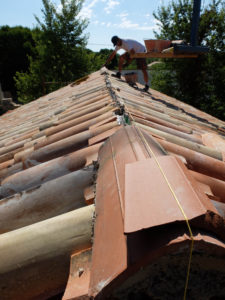
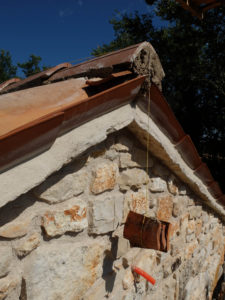
It took some more gorgeous sunrises and some more strings but there it is:

the roof 🙂